
PriceScopeWhite-label product · live with a client
Competitor prices, checked every night across a whole catalogue
Checking a competitor’s prices manually across thousands of products is not possible, so pricing decisions get made blind and corrected weeks later. This is the system that closes that gap — and the only figures on this page are read from it while it runs.
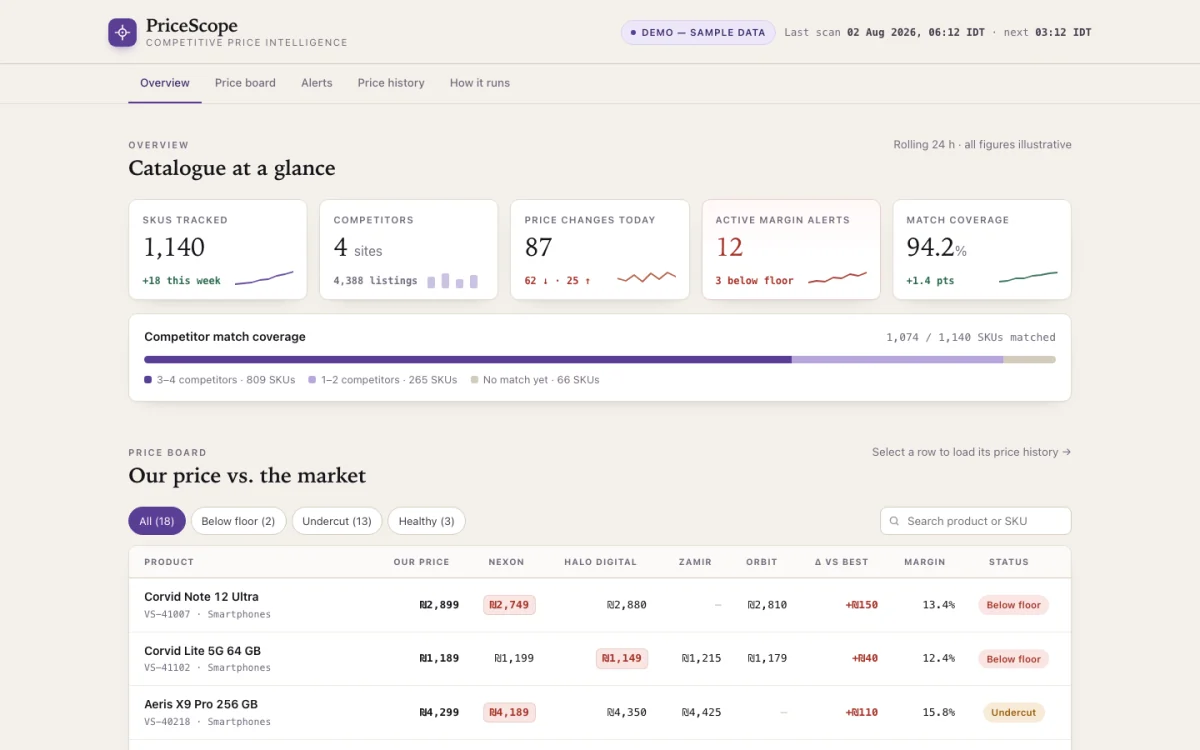
Sample data, white-labelled. The client system is private.
Price is the one lever in retail that moves margin the same day it is pulled, and it is the lever nobody can see. A competitor drops a price on a Tuesday. A supplier raises a cost on a Wednesday. The shelf price stays where somebody set it months ago.
Checking manually does not scale. One person can compare a few dozen products across a couple of competitors. A catalogue of thousands, across several competitor sites, takes longer to check than the prices stay valid — so the check either does not happen at all, or happens only on the handful of products someone remembers to look at.
What that produces is not a pricing mistake anyone can point to. It is a slow leak: items sold below the margin they were meant to hold, and items priced above the market that quietly stopped selling, with nobody connecting the two.
Six things happen between the end of one working day and the start of the next.
The mapping
Each product is mapped to the competitor listings that are genuinely the same item. This is the part everything downstream depends on for its truth, so it is maintained as the catalogue moves rather than generated once and trusted forever.
The nightly run
Every night the catalogue is worked through and the current price is read for every mapped product at every mapped competitor. It is scheduled rather than triggered by a person, so it does not depend on anyone remembering.
Margin against your own costs
Supplier costs are taken from the company’s own ERP rather than from a copy in a spreadsheet, so margin is calculated against what an item actually costs today, not what it cost when the file was last updated.
The dashboard
A tab per category shows the buying team what moved and by how much, so the conversation starts from a shared view instead of from two different exports taken at two different moments.
Alerts before the day starts
A Hebrew price and margin email arrives before the working day begins: what changed overnight, and which items have crossed below the margin they were meant to hold.
A controlled write-back
Approved price changes are written back into the ERP through one controlled path that logs every write. Nothing reaches the live catalogue unapproved, and nothing reaches it without a record of who approved it.
No vendor names, deliberately — what matters is the surfaces, not the parts.
- 01The company’s own product catalogue
- 02Supplier costs held in the ERP
- 03Competitor storefronts, read on a schedule
- 04A dashboard with a tab per category for the buying team
- 05A daily Hebrew email to the people who set prices
- 06A logged write path back into the ERP
The scraping is the easy half. The work is in the mapping — establishing that this product and that listing are the same item, and keeping that true as both catalogues move — and in everything that has to happen when a source changes shape overnight without announcing it.
In the terms used on the cost guide this is scheduled collection plus reporting, with two things that push it beyond a report: a definition of margin that has to match how the business already thinks about margin, and a write path into a system of record that has to be safe. That last part is the line between a dashboard and a system.
These three figures are read from the running system, not estimated. They are the only production figures published anywhere on this site.
- products price-checked nightly
- 1,121products price-checked nightly
- competitor sites parsed
- 8competitor sites parsed
- scheduled jobs, each alerting on failure
- 10scheduled jobs, each alerting on failure
Current as of August 2026. The client is not named, deliberately — the system is theirs.
Delivered June 2026 and running in production under a monthly support retainer. It exists as a white-label product, so the same system can be rebuilt on another retailer’s catalogue and another competitor set.
Does this describe your operation?
Five to ten minutes on the phone is enough to tell whether the same shape of system fits what you are running — or whether it does not.
Free · 5–10 minutes · no obligation